
The Merlin's Spirit Program

When veterans return home from extended tours of duty, it’s cause for celebration. But unexpected feelings of isolation, anger, grief, and shame all too easily lead to substance abuse, depression, divorce, excessive risk taking, and even suicide. Spouses, parents, and children simply aren’t equipped to deal with the “invisible wounds of war,” and natural reactions to a warrior’s emotional pain are often counterproductive. The resulting confusion can all too easily escalate into cycles of abusive outbursts, overwhelming guilt and silent alienation.

“There’s a serious lack of educational programs that assist military personnel and their families in making the smoothest possible transition from the battlefield to life back home,” says Linda Kohanov, founder/director of the Epona International Study Center, which teaches emotional fitness, relationship, nonverbal communication and leadership skills, in part through working with horses. “Many of these servicemen and women have the endurance, intelligence, and discipline to become tremendous assets to this country, but their lack of training in emotional fitness and social intelligence skills becomes a serious hindrance to long term success. Children also suffer from the resulting instability in family life, making the psychological wounds of war a multi-generational phenomenon.”

Recognizing that funding sources tend to favor people with serious clinical depression and post traumatic stress disorder (PTSD), Kohanov and her colleagues have created the Merlin’s Spirit Memorial Fund for returning military personnel, veterans and their families. Named for Kohanov’s stallion Midnight Merlin and his son Spirit, the program teaches people advanced personal and professional relationship skills, empowerment, and resilience in the face of traumatic events.

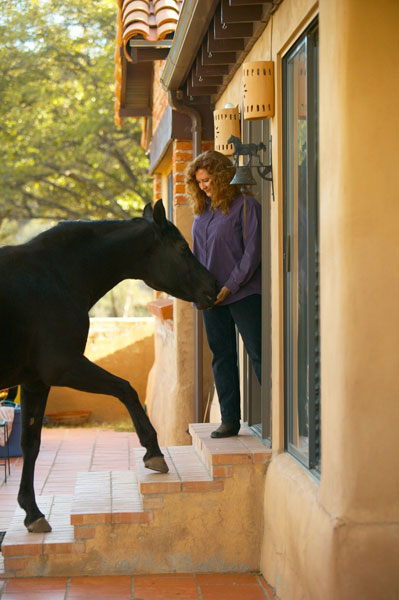
Merlin and Spirit When Kohanov met Merlin in 1999, he was a stunning black stallion with tremendous untapped potential, but early training made him so dangerous and unpredictable that he had to be kept in an isolated corral. “Some techniques used in training show horses are the same techniques that were traditionally used for war horses,” Kohanov reveals. “In the wrong hands, these practices become abusive, creating volatile, rage-filled horses. In rehabilitating Merlin, I realized that he had many of the symptoms that veterans with PTSD report, a frightening combination of power, energy and hyper-vigilance leading to explosive outbursts of anger followed by an almost unbearable combination of vulnerability, confusion and shame for his actions. He threatened my life several times, but something in his eyes kept me from giving up on him.”

In teaching the frustrated stallion how to respectfully integrate into a herd, Kohanov tapped what she calls a “fierce sensitivity” in herself and her mares. She learned to set strong yet compassionate boundaries with Merlin while helping him break the cycle of rage and shame that kept him isolated from humans as well as other horses. And she began teaching these same skills to people through activities with gentler, specially trained horses, chronicling her experiences in three best-selling books.

Merlin and Spirit“Merlin had the most profound affect on veterans, who very much related to his story,” Kohanov reports. “They observed that it was a more difficult, arguably heroic act for Merlin to learn a new way of relating to the world than it was for him to keep reacting out of fear and anger. Seeing this powerful stallion living peacefully with his mares and working with his son Spirit, who sired his own daughter in 2008, would bring tears to their eyes, filling them with tremendous respect for their own challenges in returning to life back home. The fierce sensitivity I engaged with Merlin turned out to be an essential ingredient for family members to adopt in order to help their loved ones transform the intense emotional pain that many military service men and women feel in the wake of the all too common traumas of combat. ”

When Merlin died in February of 2009, the outpouring of cards and emails from around the world was startling to Kohanov and her staff. “People were asking for ideas on how they could contribute in his memory,” she says. “It occurred to me that the best tribute to the lessons Merlin taught us would be to create a fund to assist military service men, women, and their families in finding the same sense of peace and power that he eventually achieved.”

Donations to Merlin’s Spirit Memorial Fund, a division of the Headlands Foundation, support workshops that teach military personnel and their families how to deal constructively with the challenges of re-integrating into society. “It’s simply impossible for soldiers who’ve faced the intensity of combat to go back to the way they were before they left,” Kohanov stresses. “These people are warriors. They’ve been initiated through extreme experiences, and it’s important for us to not only realize this, but to support the reentry process more effectively. At the same time, veterans need to learn new skills for channeling their tremendous power and energy into peacetime pursuits. For the vast majority of service men and women, this is not a therapy issue. It’s an educational issue. The stigma often associated with therapy in the military should not prevent people from getting the social intelligence and emotional strength training they need to excel. They made tremendous sacrifices for our safety. It’s in everyone’s best interest to help them find happiness and success in life.

“Spirit and his brothers ultimately benefited from their father’s journey to greater health and balance. With the cycle of isolation, rage, shame and abuse broken, Merlin’s sons—and his little granddaughter—are among the calmest, bravest, yet most spirited and personable horses you’ll ever meet. They now teach people from around the world how to move through their own challenges to better serve society and nourish future generations.”

A Veteran's Perspective

“Throughout history we have trained horses for success in combat,” says Terry Murray, Navy veteran and apprentice at the Epona Center. “Today, there’s a poetic irony in the way horses are teaching veterans how to succeed in civilian life.”

The issues involved are complex. Military socialization, beginning with boot camp, breaks down self-esteem and replaces it with unit-esteem in order to create a cohesive fighting unit. “Leaving their comrades in arms on the battlefield often creates feelings of betrayal, guilt and a powerful sense of loss,” Terry observes. “Your sense of identity, of being a soldier and an integral part of a unit, is fractured when you return home.”

Moving from warrior culture to a thriving mentality is fraught with emotional difficulties. “Soldiers are trained incessantly to survive, creating a kind of muscle memory under the severe stress of combat,” he says. “They do not have time to process or grieve the violent injuries and deaths of their closest friends. A numbing of emotion occurs to serve the survival of the unit.” This numbing effect, coupled with an interrupted sense of self-esteem and episodes of survivor’s guilt, quickly become problematic in civilian life.

“It’s very helpful for returning military personnel to learn some emotional intelligence skills to process and manage the experiences of their transition,” Terry emphasizes. Aside from the obvious benefits in healing trauma and building strong personal relationships, emotional intelligence (EQ) has also statistically been shown to be four times more important in determining success in business than raw IQ and training. From manufacturing to sales to science, people with high EQ show greater productivity and personal advancement, generating significant revenue increases for their companies with less turnover and accidents. The military has begun to recognize the importance of these so-called “soft skills.” When the U.S. Air Force selected recruiters with high EQ, they experienced in a threefold increase in the number of recruits while generating a savings of $3 million annually.

Terry, who was stationed on an aircraft carrier during his military career, is now a successful business consultant and coach. Attending advanced leadership training at the Epona Center in 2008, he was impressed with how the specially designed equine activities enhanced EQ. As a result, he joined the 2009 Epona Apprenticeship Program to learn how to employ horses in training executives, management teams and veterans.

 “Working with the horses creates an immediate shift in perspective by elevating self-awareness and self-esteem in a safe, confidential, and non-judgmental way,” he says. “Within this space, my sense of authentic self emerged, displacing the conditioned self I’d come to embrace.  I’ve experienced powerful life metaphors in ten minutes with the horses that took me ten years to learn as a corporate leader, and I’ve mastered new EQ skills in record time.  As a veteran who has successfully navigated the journey home, I greatly appreciate how this can accelerate the transition back to civilian life while maintaining the positive skills service members acquire while serving our country.”

Terry applauds the Merlin’s Spirit program for including family members in re-entry training. “During deployment, the family dynamics shift,” he observes, “with the spouse taking on new areas of responsibility and authority vacated by the soldier overseas. Upon return, there can be apprehension over redefined roles and power dynamics. Horses teach us the value of healthy boundaries. Soldiers are not allowed boundaries in the military. They live and die under authoritative rule; unit identity doesn’t allow for individual space. By practicing how to gently yet effectively set boundaries with a 1,000 pound horse—and learning how to translate this skill to human interactions—reuniting families begin to renegotiate their relationships from a place of understanding and respect.”

Finally, Terry notes, returning veterans face the challenge of entering a much more ambiguous culture. “In the military, everything is regimented and social status is plainly displayed on a person’s sleeve or collar,” he says. “The Epona program in particular teaches people how to be fully present and aware while collaborating continuously with change. The horses engage a new sense of balance-in-motion that empowers us to stay engaged even in highly ambiguous situations.”


to top