
Epona's Innovative Stallion Program

Epona's new stallion program has already been profiled in several respected horse publications, including a two-part feature in Equine Journal and an article in Horse Connection. The following description is adapted from the Equine Journal article by Kip Mistral.

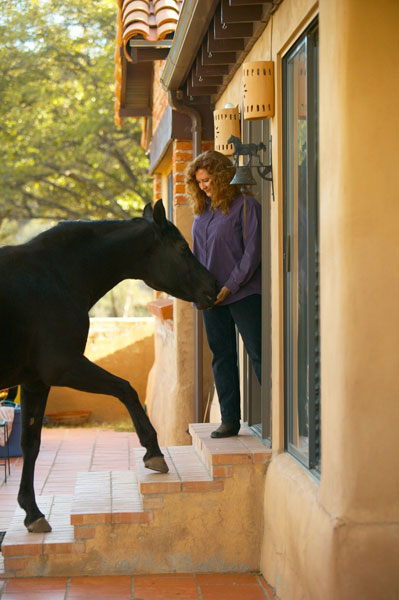
Spirit and Merlin

“If you consider the average stallion's life—kept in a box stall with bars, led from stall to turnout that is remote from other horses—the isolation of this kind of life would be considered imprisonment if the subject were human. Kohanov has come to believe this lack of opportunity to participate in normal herd behavior creates and compounds such anxiety that the prospect of even being near any other horses is emotionally overwhelming. It can be difficult or even impossible for this stallion to control himself, let alone allow himself to be controlled.

“Kohanov feels that these typical circumstances prevent a stallion from thriving, a word used infrequently these days that means to grow and prosper richly. She decided to create a unique Epona program for socializing stallions with their owners/handlers. The program is intended to help stallion owners create living environments modified to help stallions not just survive, but thrive."

An Epona Team Effort

The new stallion program is truly a team effort because Kohanov has welcomed the participation of two professional horse trainers, Stacey Kollman and Shelley Rosenberg, both of whom trained Kohanov before she formed Epona. Together they are now developing a program to socialize stallions with other horses, so intact male hores can have fulfilling lives, and help owners and trainers learn effective new techniques of managing stallions.

A New Level of Relationship

“I had this feeling, which turned into a vision," Kohanov recounts, "that stallions should have their own fulfilled lives in which they could actually live in relationship to other horses. At the same time they could learn to collaborate with humans safely and respectfully—come out every day and work with people, compete if appropriate, even teach people how to be with stallions in a new way—while also returning home to their own herds at the end of the day. In working with our formerly abused stallion, Midnight Merlin, and later his son, stud cold Spirit, we gained confidence that this was indeed possible, and our team of experienced trainers is ready to share these insights and techniques with others."

Rubbing Heads

Since the Epona stallion program is individualized to each stallion and the relevant issues and humans in his life, the Epona staff thoroughly assesses the scope of the project over a week-long evaluation period where the stallion stays at Apache Springs Ranch.

After the stallion has been evaluated and his program developed, the Epona trainers will work with him before his human partners arrive to become part of the process. As Rosenberg says, "Ultimately, the goal is to assist your stallion and you both to learn to relate on a different level."

Horse-to-Horse Integration

In the case of stallions entering into short-term training (three months or less), such horses will not be integrated into the Epona herd, but they will have more space and freedom than they experience at mainstream boarding and training facilities. Training for both the stallion and his handler/owner or trainer is involved. People learn how to assess their own stallion's arousal level as well as their own, as the stallion is taught how to become empowered yet respectful of other people and horses, and ultimately to enjoy his life.

"Students can be part of our living laboratory where they learn the ways that we prepare a stallion to live with his band of mares, or we prepare a stud colt to learn how to be with other horses in a field," Kohanov says. "After, they can take the stallion home to their own farm, or if they need troubleshooting—for instance, as they are integrating the stallion with mares at their farm—our stallion specialist Shelley Rosenberg can travel there to provide support."

The Larger Vision

People who would like to do an intensive study program or longer-term internship in stallion training can study at the Epona Center with or without their own stallion on site. Some horse experience is necessary for entry into this program. Contact Shelley Rosenberg for more information at shelley@theeponacenter.com or 520-455-5918.

"Learning to channel masculine energy translates to a larger vision for humanity," Kohanov says. "At Epona we are teaching cooperation, rather than competition. This stallion program is for people who are really serious about changing the paradigm in which they relate with their stallions as well as the conditions in which the stallions live.”

Stallion Training Opportunities

Epona's Stallion Program offers two possibilities:

  1. Bring your horse to Epona for a minimum of 2 to 3 months where he will be trained in Epona's innovative approach. At some point during that time, the owner or trainer will travel to Epona to receive lessons in these same handling and socializing techniques. After returning home, if further assistance is needed, an Epona trainer can travel to your place to help with integration.
  2. Trainers can come and spend time at Epona learning the stallion training methods being pioneered here in a program individually tailored to meet their needs.


to top